
ABOUT KOOHUB

Infrastructure built to last

From understanding the energy of flowing water to developing water and gas technologies: a journey grounded in design, fabrication, testing and refinement.

Koohub began with a question: how can infrastructure use less energy, remain simpler, last longer and improve lives over time? This question underpins our approach to hydraulic systems and our choice of new research and fabrication directions.

Explore the work before HMTR
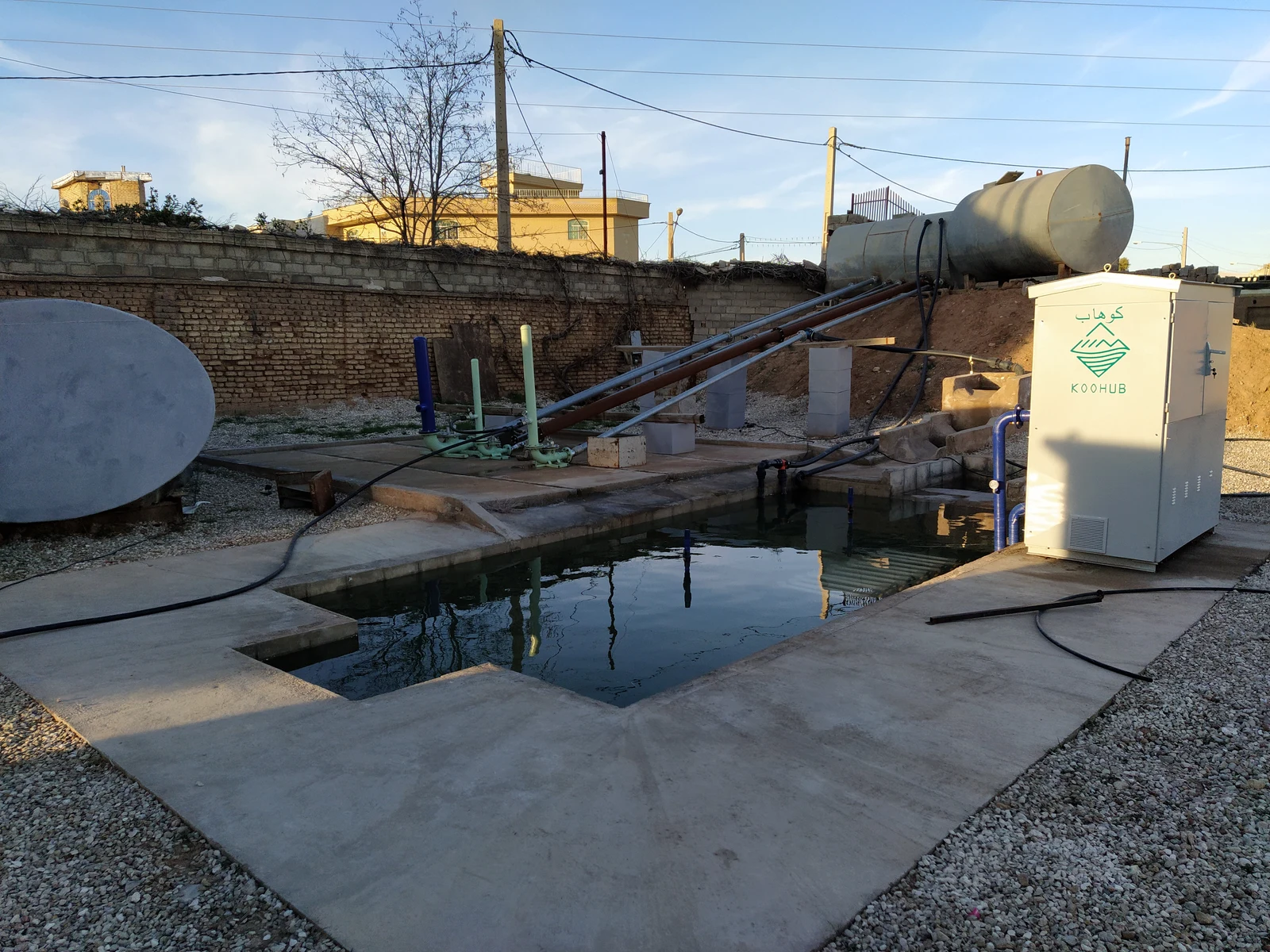
Koohub test site with a water tank, test pipework and equipment prototypes
Koohub’s testing and prototyping site, from the work preceding HMTR

A question before a company

Koohub’s journey began years before the company was established, with Ehsan Parandin’s interest in the design and evolution of infrastructure. Transport, energy and systems that were simpler to operate were among the first areas explored. The shared concern was durable infrastructure suited to its environment, whose value becomes evident throughout its operating life.

Water and energy gradually became the focus: a field where ideas could be built, tested in real conditions and assessed through their results. Kooh Ab Energy Avisa was established on 14 Aban 1397 (Solar Hijri) and continued this work under the Koohub brand.

Qanats, traditional ice houses, wind-powered mills and other enduring structures exemplify an understanding of the environment and intelligent use of natural resources. Studying and visiting Shushtar’s hydraulic works reinforced our view of flowing water as a source of energy and support for varied activities. We pursue the reasoning behind these designs: meeting today’s needs through environmental potential, suitable materials and modern calculation and testing tools.

Before HMTR: the work that shaped the direction

Some projects overlapped in time. Each experience sharpened the criteria for choosing and designing the next.

Hydraulic ram pumps: harnessing the energy of flow

Building and testing hydraulic ram pumps was among Koohub’s earliest practical work. It began by studying successful historical designs. Investigating the kinetic energy of water, water hammer and the influence of site conditions led to a proprietary design for operation with muddy water.

Prototypes with outlet pressures up to 25 bar were built and tested. Following laboratory trials, they were installed at four natural sites for extended evaluation. A 40 bar prototype was subsequently tested to investigate single-stage reverse-osmosis desalination using the energy of saline river flow, yielding positive results. This work deepened our understanding of water-flow behaviour, led to one registered invention, and earned the top-idea award at Iran’s second national festival of leading agricultural ideas in 1399 (Solar Hijri).

Key lesson: a hydraulic system must be assessed in relation to available head, the flow path and actual site conditions.

1 / 2
Ram-pump testing beside a watercourse
Field trial footage · play on request

Flow-driven power generation: working with low head

Research into power generation from high-volume, low-head flows began with earlier approaches and modelling of Archimedes screw-based generators. A subsequent focus on small, portable prototypes enabled practical investigation of turbine geometry and performance under different flow conditions.

The work produced two portable generators supplying mechanical power for reciprocating and rotary motion. It also led to two registered inventions concerning the use of flowing-water energy and Archimedes screw geometry.

Key lesson: output power must be assessed alongside durability, maintenance requirements and changing flow conditions.

1 / 1
Flow-driven prototype during testing in a watercourse
Field trial footage · play on request

Ejectors: evaluating gas transfer in real conditions

Designing and testing ejectors in aquaculture extended Koohub’s research into gas–liquid contact and the role of flow in oxygen delivery. Different arrangements were built and tested, with performance evaluated through two complete trout-growing cycles, from beginning to end.

The experience showed that process outcomes are only one criterion in technology selection. Energy consumption, ease of installation, cleaning and serviceability must also inform decisions about further development and production.

Key lesson: promising initial results must be followed by assessment over a complete operating cycle.

1 / 2
Ejector testing in a fish-culture raceway
Field trial footage · play on request

Microbubble generators: beyond bubble production

Building and testing microbubble generators enabled investigation of bubble size, two-phase flow behaviour and gas transfer into liquid. The experience gained in bubble generation and management later contributed to HMTR development.

However, assessment of energy efficiency, operating capacity and maintenance costs showed that the investigated prototypes were not suitable for continued production in Koohub’s intended direction. The knowledge gained helped select and develop the next approach.

Key lesson: bubble size alone does not establish performance; gas flow, effective transfer into liquid and energy consumption must be evaluated together.

1 / 2
Microbubble generator and test basin
Field trial footage · play on request

The path to HMTR

Work on ram pumps, flow-driven generators, ejectors and microbubble generators expanded Koohub’s understanding of water behaviour, flow energy and gas–liquid contact. Studying hydraulic air compressors opened a new direction: using water flow to compress air and convey it to the point of use. Investigating low-head conditions and passive and pumped arrangements provided the basis for further research.

As design and testing progressed, the scope expanded beyond compressed-air production to gas dissolution in liquid, microbubble generation and management, and recovery of unused gas. Airlift development connected these capabilities with tank circulation and mixing. Koohub’s HMTR and airlifts grew from this continuous process of design, fabrication, field testing and refinement.

These products are ready for supply and have real operating experience. The next research stage evaluates integrated-system process performance in activated-sludge aeration with deep injection and dilution management, and explores ozone use in advanced oxidation processes (AOP). These evaluations develop specific applications and are separate from equipment design and fabrication readiness.

The five stages of HMTR development

Join the next step

Koohub welcomes industrial partners, researchers and investors to develop new applications, carry out independent trials and evaluate performance at industrial scale. These collaborations aim to turn testable ideas into practical, durable solutions, considering performance, water and energy use, operating costs and environmental effects from the design stage.

Discuss a collaboration