
Airlift
One hydraulic principle, two applications
An airlift pumps or circulates liquid by introducing air and creating a density difference between the air–water column and the surrounding liquid, producing upward flow. Koohub designs and manufactures airlift pumps and mixers for each project. Alongside HMTR, they can use recovered air for water transfer, circulation and tank mixing.
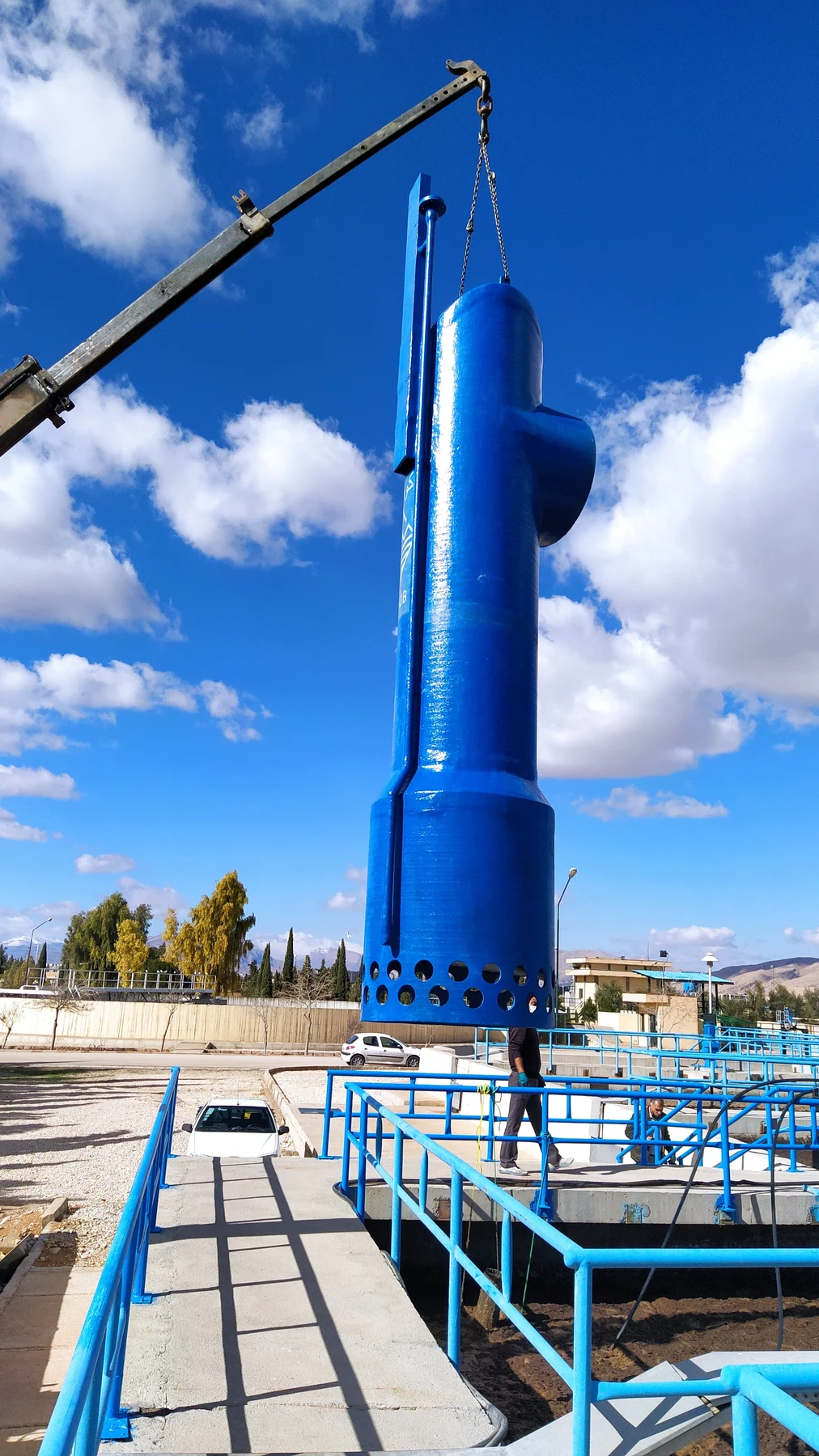
Koohub airlift mixer
High-volume circulation with submerged discharge
Koohub airlift mixers circulate and mix large volumes of water without lifting it above the free surface. Liquid enters at the bottom, rises and returns to the tank through lateral or radial outlets. Combined with HMTR, this circulation helps distribute and dilute the gas-enriched stream in the tank.
Airlift mixer construction & installation
Koohub airlift bodies, pipework and fittings are made from composites. Dimensions, outlet arrangements and attachment methods are selected for tank depth and installation conditions. Airlifts up to 1 m in diameter have been built, installed in tanks 3, 4.5 and 6.5 m deep, and evaluated over extended operation. Design and fabrication capability extends to 4 m diameter. Equipment-specific attachment points facilitate installation, handling and removal from the tank.
Airlift in a field trial
Airlift pump
Transferring water and solids-bearing fluids
Airlift pumps move water to a higher level and can be used for high-flow, low-head duties. The fluid path has no impeller, shaft or mechanical seal: a simple structure that can pass water, sludge and solid particles within its design dimensions and conditions.
- Water circulation in recirculating aquaculture systems (RAS) and raceways.
- Transfer of water, sludge and suspended-solid streams in treatment plants.
- Water transfer with gas exchange, supporting aeration and degassing.